Research status: Desk research, not personally tested. Formulation details and market benchmarks checked 6 October 2026.
The short answer
In Japanese skincare engineering, sunscreen texture is not just an aesthetic preference—it is a physical delivery vehicle. Choosing between a watery gel, a shaka-shaka milk, and an airy essence determines whether your SPF survives an 80% humidity morning commute or dissolves into your collar before you reach the office.
For tropical Southeast Asia (Kuala Lumpur, Jakarta, Singapore) and warm US climates, three core vehicle architectures dominate the market:
- Watery Gels & Essences (Oil-in-Water / O/W): High-fluidity water/ethanol continuous phase that delivers a weightless cooling sensation and zero white cast. Ideal for daily casual wear and indoor desk days, but prone to re-emulsifying under intense sweat if not allowed to polymerize undisturbed.
- Shaka-Shaka Milks (Water-in-Oil / W/O): Volatile silicone continuous phase housing micro-dispersed zinc oxide or titanium dioxide. Unmatched water- and sweat-repellency that creates an ultra-durable hydrophobic shield, but requiring dedicated cleansing oil removal.
- Friction-Resistant Resin Networks: Advanced hybrid crosslinked polymer veils (such as Shiseido's Auto Repair and Kanebo's Friction-Proof Tech) engineered specifically to withstand physical abrasion from phone screens, masks, and collar rub.
On @cosme’s sunscreen rankings and MAQUIA expert curations in October 2026, Japanese consumers increasingly rotate formats based on humidity index and activity rather than sticking to a single bottle year-round.
Four bottles, four tropical wear profiles
1. Anessa Perfect UV Skincare Gel NB (Hybrid Friction Veil)
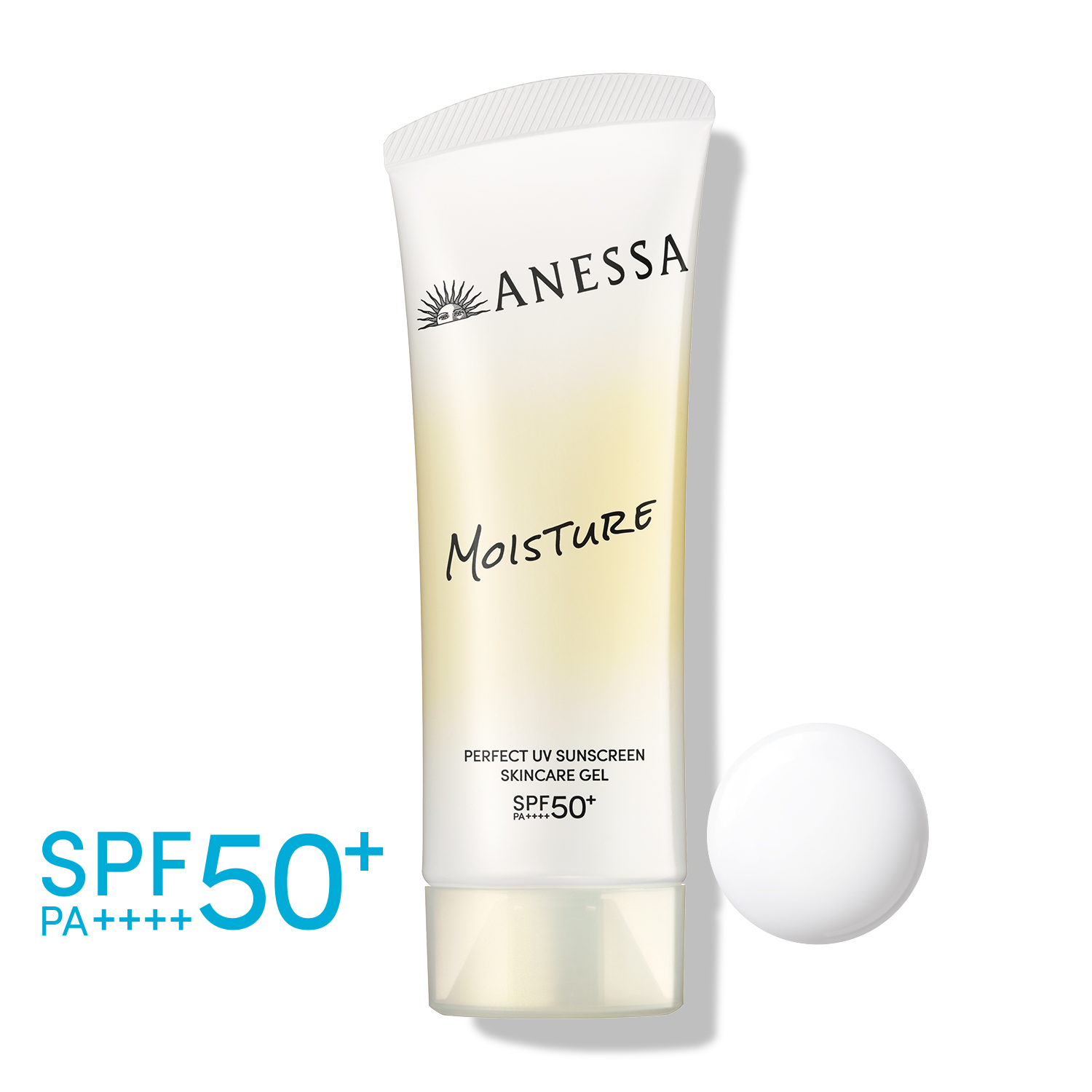
Shiseido’s official directions specify dispensing an approximate 1.2 cm diameter pearl-sized drop (about 0.8g) onto palms after morning watery lotion or moisturizer. Dot across the five facial zones—forehead, nose, chin, and both cheeks—and smooth outward along facial contours without aggressive dragging.
Anessa’s 2024–2026 renewed Gel formulation features upgraded "Auto Repair Technology" and "Auto Booster Technology." While traditional gels can crack along natural facial expression creases (nasolabial folds and crow's feet) when stretched by facial movements, Anessa's flexible polymer film self-heals micro-fissures. In 32°C wet heat, ambient humidity triggers the film formers to bond more tightly rather than liquefying. It sets to a radiant satin finish with zero chalkiness, washing clean with standard facial cleanser or foaming soap.
Official price benchmark: RM109 / Rp 425.000 / $24 (90 g).
2. Curél UV Protection Milk SPF 50+ (Physical Barrier Shield)
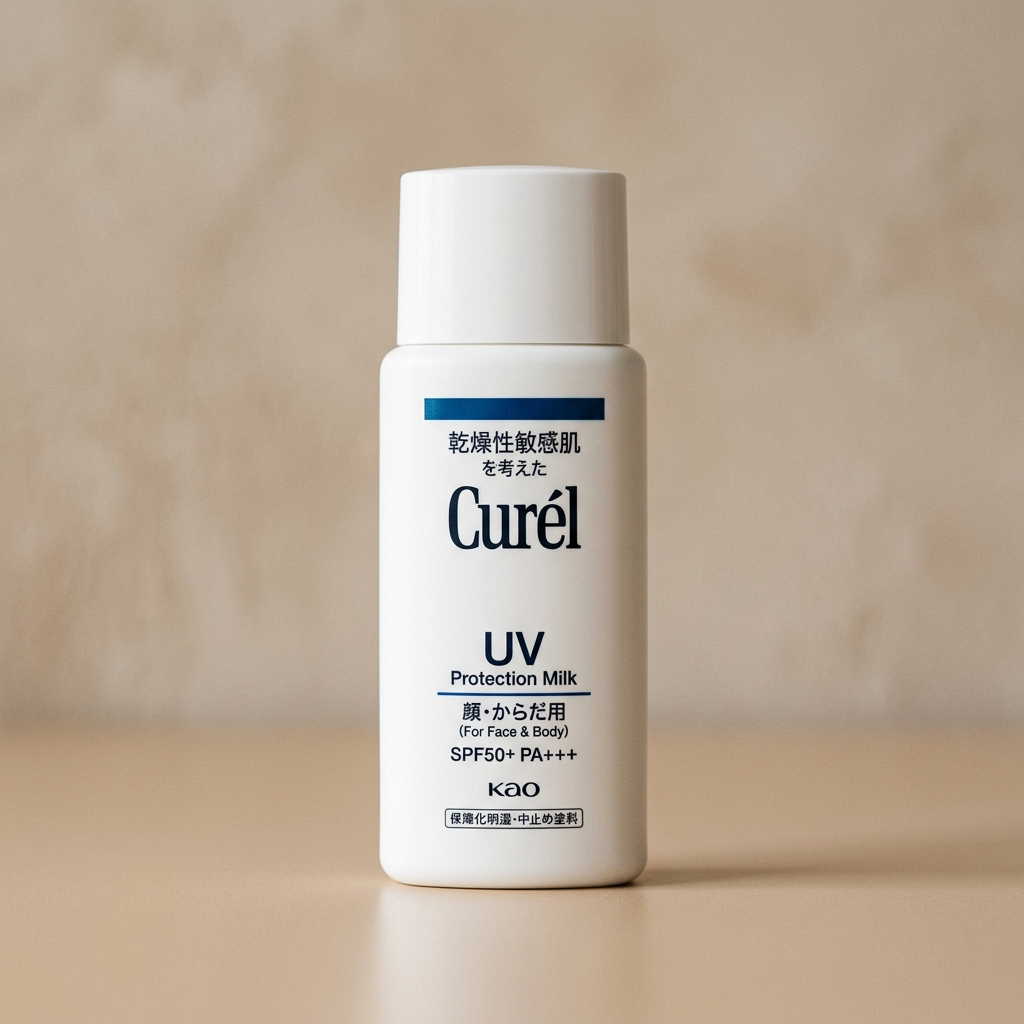
Kao directs users to shake the bottle thoroughly until the internal steel ball rattles freely, then dispense an approximate 2 cm coin-sized pool into cupped palms. Smooth gently over the face and neck in light upward strokes, allowing the volatile silicone carriers to flash off naturally.
Curél UV Protection Milk is formulated specifically for hyper-sensitive and barrier-compromised skin using 100% physical mineral filters (Zinc Oxide and Titanium Dioxide) without organic chemical absorbers, fragrance, or drying alcohol. Its vehicle is a classic Water-in-Oil (W/O) emulsion enriched with Kao’s synthetic pseudo-ceramide (Cetyl-PG Hydroxyethyl Palmitamide) and eucalyptus extract. When applied, volatile cyclomethicones evaporate within 45 seconds, depositing an airtight mineral veil that locks in stratum corneum moisture against aggressive air-conditioned office draft while deflecting environmental allergens.
Official price benchmark: RM88 / Rp 310.000 / $20 (60 mL).
3. Kanebo ALLIE Chrono Beauty Gel UV EX (Anti-Transfer Shield)
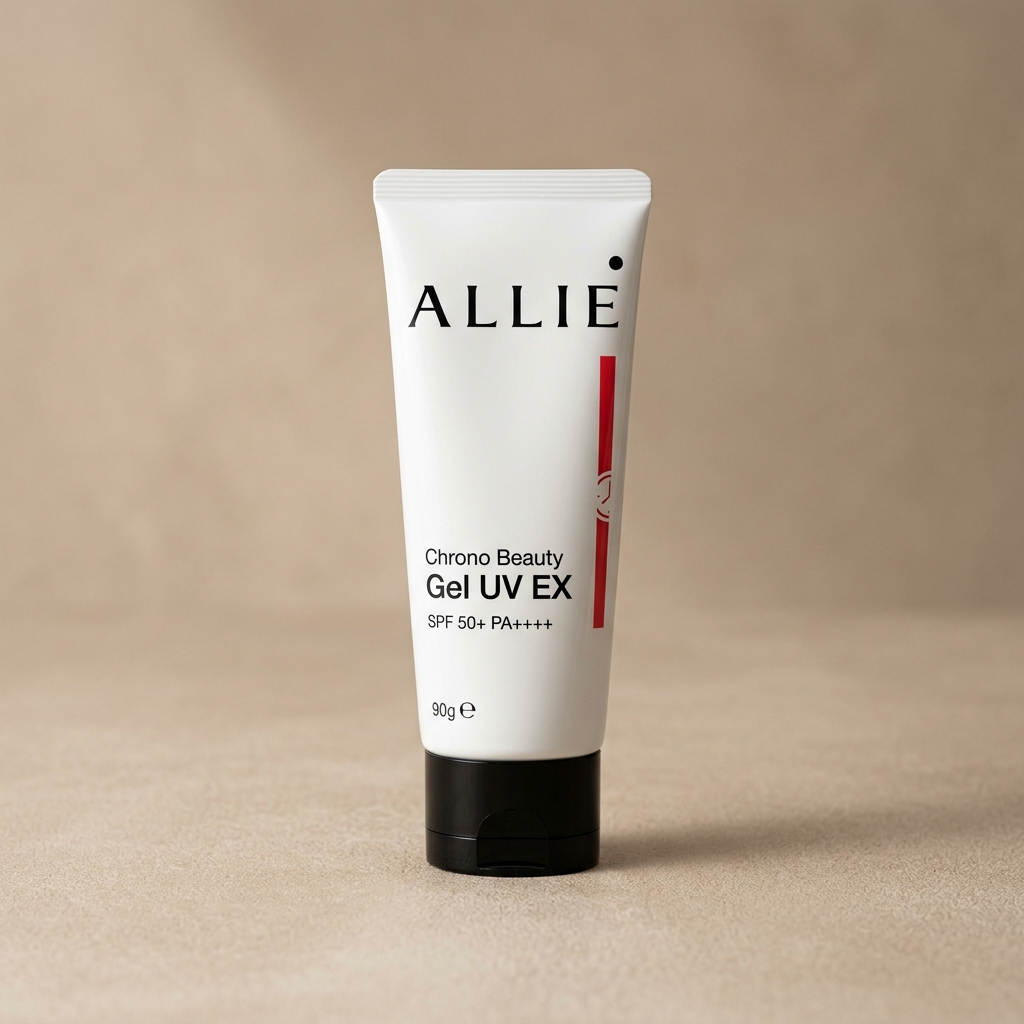
Kanebo directs dispensing an approximate 1.2 cm pearl onto fingertips after skincare, blending evenly from the center of the face outward. For neck and décolletage, apply in gentle sweeping motions from jawline to clavicle.
ALLIE Chrono Beauty Gel UV EX is built around Kanebo’s patented "Friction-Proof" resin technology. In high-density urban transit—such as crowded LRT or MRT commutes—standard sunscreens rub off against tote bag straps, collar edges, and tissue dabbing. ALLIE incorporates an elastic elastomer coating that flexes under physical pressure instead of flaking or wiping off. Its formulation is reef-friendly compliant and fragrance-free, providing an 80-minute water-resistant film that leaves a transparent, porcelain-soft sheen without oiliness.
Official price benchmark: RM105 / Rp 390.000 / $23 (90 g).
4. Bioré UV Aqua Rich Airy Hold Cream (Semi-Matte Sebum Control)
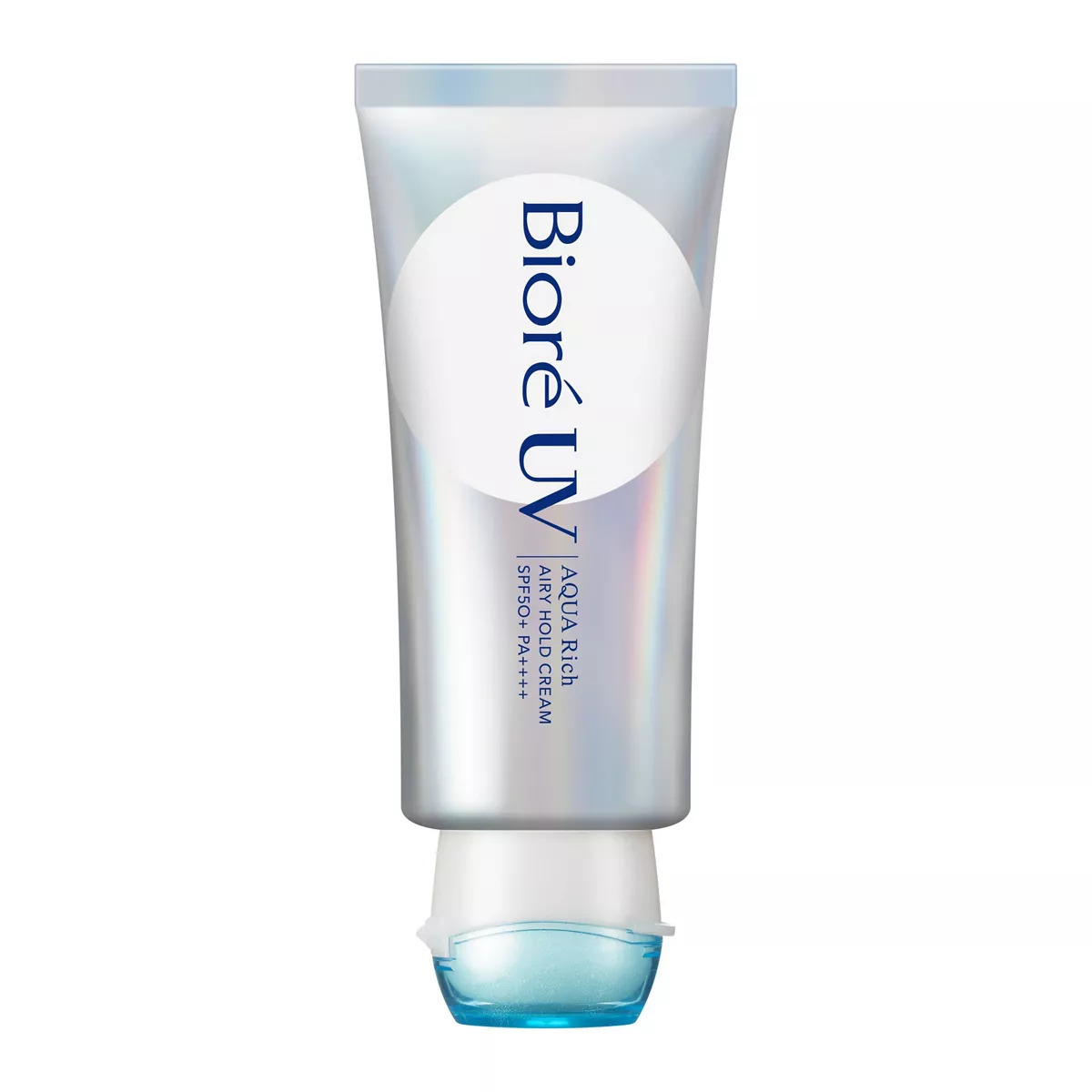
Kao Bioré directs applying an approximate pearl-sized amount across the entire face as the final step of morning skincare, focusing with a gentle pressing motion on the forehead, nose bridge, and center of the chin.
Airy Hold Cream was developed directly to solve the midday "oil-slick" dilemma common in tropical urban climates. Utilizing Kao's micro-capsule dispersion technology paired with porous sebum-adsorbing silica micro-powders, the formula absorbs excess skin triglycerides as they are secreted throughout the day. It dries down to an imperceptible semi-matte finish within 15 seconds, creating an optical soft-focus blur that prevents greasy sunscreen shine from breaking through midday foundation.
Official price benchmark: RM48 / Rp 165.000 / $12 (50 g).
The science: Oil-in-Water (Gel) vs Water-in-Oil (Milk)
Understanding why certain sunscreens slide off your face requires looking at the emulsion chemistry:
- Oil-in-Water (O/W) Emulsions (Watery Gels & Essences):
Water forms the external continuous phase, holding microscopic droplets of oil-soluble UV filters in suspension. When applied, the water and ethanol flash off quickly, providing an instant refreshing burst and featherlight spreadability. However, because water is the outer carrier, heavy perspiration or rainwater can temporarily re-emulsify the film before the crosslinked acrylic polymers have completely set. - Water-in-Oil (W/O) Emulsions (Shaka-Shaka Milks):
Silicone or lipid oil forms the continuous outer layer, encapsulating microscopic water droplets inside. Because oil and water repel each other, perspiration beads roll off the surface without disturbing the underlying UV filter layer. This makes milks structurally superior for prolonged outdoor exposure, maritime sports, and heavy sweating. The trade-off: they require lipid-solubilizing cleansing oils to remove thoroughly at night. - Resin & Elastomer Friction Networks:
Standard polymers form a rigid crystalline mesh on skin that shatters when subjected to mechanical friction (collar rub or towel dabbing). Modern Japanese formulations introduce flexible silicone-urethane resin chains that deform reversibly under shearing stress, maintaining uniform UV protection across high-friction contact zones.
Evidence boundary: While Japanese Quasi-Drug and high-SPF ratings provide rigorous broad-spectrum UVA/UVB defense under laboratory test protocols (2 mg/cm² dose), real-world protective retention drops significantly if user dose is skimped or if mechanical rubbing physically strips the film.
Technique & routine guidance: The 60-to-90-second settle
Achieving seamless, pill-free sunscreen wear under tropical conditions requires observing three application protocols:
- The 60-to-90-Second Settle: Never rush into foundation or concealer immediately after spreading sunscreen. Allow 60 to 90 seconds for volatile solvents (water and alcohol) to flash off and acrylic film-formers to coalesce into a uniform, hydrophobic matrix. Applying makeup over a wet sunscreen film mechanically shears the emulsion, resulting in pilling and patchy protection.
- Directional Patting over Rubbing: When layering sunscreen over a hydrating ceramide lotion or vitamin C serum, use wide, directional smoothing strokes followed by gentle palm pressing. Vigorous back-and-forth circular rubbing shears the drying polymer chains, causing them to ball up into rubbery debris along the jawline.
- Targeted Cleansing Pairing: Match your evening cleanse to your sunscreen vehicle. Watery gels (Anessa Gel, Bioré Airy Hold) wash off cleanly with a single foaming face wash. Water-in-oil milks and friction-proof resin veils (Curél Milk, ALLIE) require an emulsifying cleansing oil first to dissolve the stubborn silicone film without aggressive scrubbing.
Layerwise climate note: Kuala Lumpur, Jakarta & Tokyo/US
In Kuala Lumpur and Jakarta, ambient relative humidity routinely exceeds 80% with ambient temperatures above 32°C. Commuting between muggy outdoor heat and refrigerated office interiors (21°C, 45% RH) creates severe thermal-osmotic stress on topical products. A watery gel or airy sebum-control cream prevents suffocating pore occlusivity during transit, while a friction-resistant resin shield prevents collars from turning yellow.
In Tokyo and across North America during autumn and winter, outdoor air drops below 15°C with indoor heating running continuously. Here, the humectant-dense film of a ceramide milk (such as Curél) prevents rapid trans-epidermal water loss (TEWL) and protects wind-chapped skin from moisture depletion.
Seven-day observation checklist
When introducing a new Japanese sunscreen format to your morning routine, evaluate these four observable benchmarks over your first week:
- Ocular Stinging & Sweat Drift: Note whether midday forehead perspiration carries organic filters down into the eye contour, causing stinging, burning, or watery vision.
- Hairline & Jawline Pilling: Inspect the perimeter of your face 15 minutes after makeup application for rubbery grey or white rolls of pilled product.
- Collar & Mask Transfer: Check white shirt collars and dark mask interiors for yellowing, oily streaks, or chalky mineral transfers after a humid commute.
- Midday Shine vs Dry Tightness: Audit your skin at 3:00 PM in natural light. Does the T-zone shine with excessive sebum, or does the skin feel taut and parched around the mouth?
Stop-use and medical boundaries
Topical sunscreens are preventative photoprotective barriers designed for healthy skin; they are not medical treatments for active dermatological conditions such as acute polymorphic light eruption, rosacea flare-ups, or solar keratosis. If your skin exhibits burning sensation, contact dermatitis, persistent erythema, or urticaria upon sunscreen application, rinse immediately with lukewarm water and discontinue use. Any persistent, changing, or irregular pigmented spots should be examined promptly by a board-certified dermatologist.